So You’ve Got your Feedback. What next?
Hello everyone,
Your feedback is here! Now, hang on a second…don't do anything rash…
Plus, a little advice about editing, submitting too soon and giving your novel its best chance.
But first things first ….All our competition feedback has now been sent out! 🎉
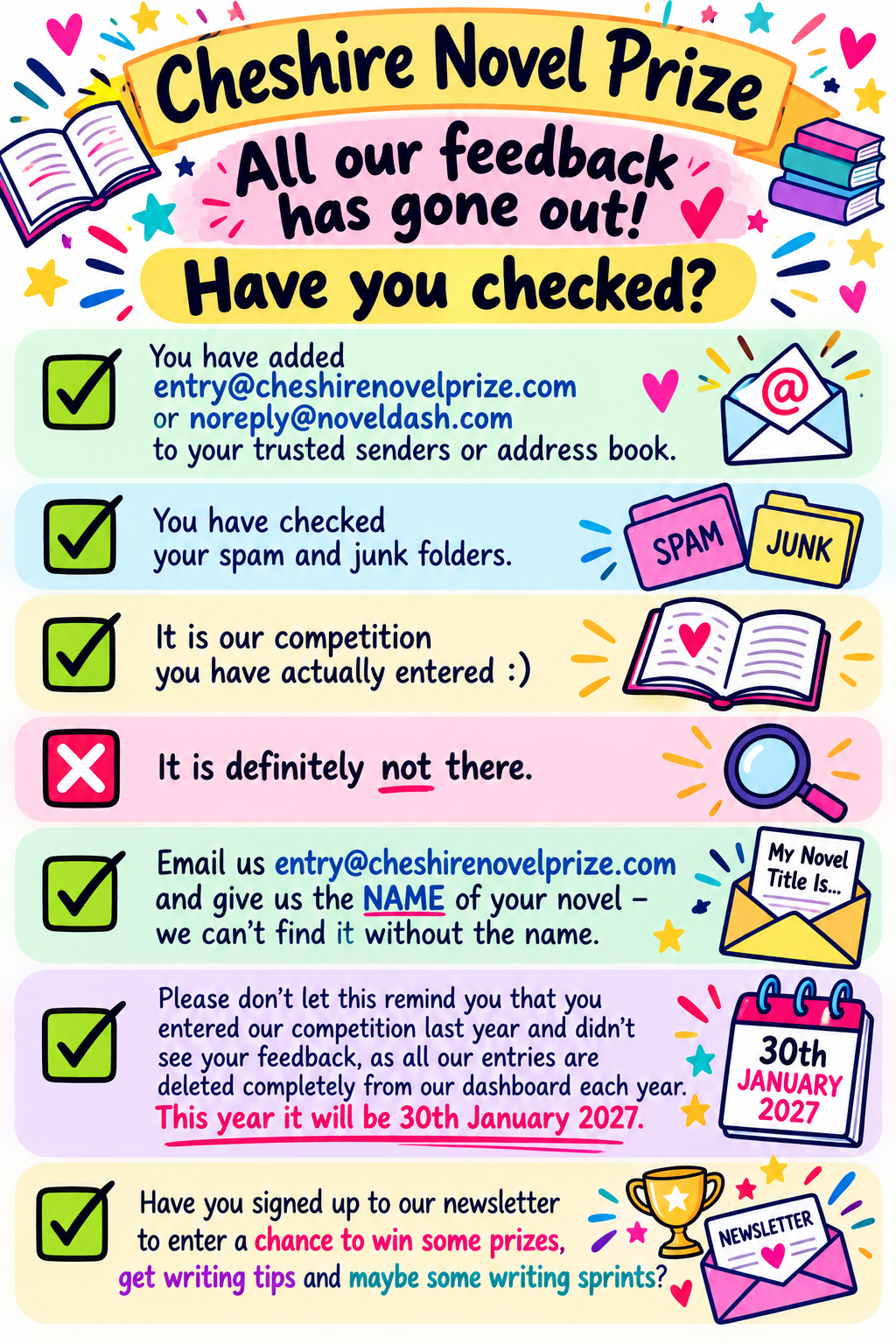
If you haven't received yours yet, please check the image above and follow the steps outlined there before emailing us. It's worth checking your spam and junk folders too, as emails do have a habit of disappearing into the depths of those!
But the competition isn't over yet!
We still have 11 longlisted writers in the running for our Winner and Highly Commended. Over the next few weeks, we'll be sharing more about these novels, what made them stand out from the hundreds of entries we received, and why they were chosen.
Hopefully, this will give you a little insight into what catches our eye as judges and what makes a manuscript rise to the top.
So…you’ve got your feedback.
Now what?
Well, my first piece of advice is this: You need to calm down :)
Don't charge at your manuscript like a bull in a china shop and try to fix absolutely everything by teatime. I know how tempting it is. You've waited patiently for your feedback, you've finally got some fresh eyes on your work, and now you're desperate to get stuck in and give all the agents on your list a chance to snap it up.
But please, please, please… slow down.
Because one of the biggest mistakes I see writers make is submitting their novels far too early.
And there are three reasons why this happens.
1. You're too close to your own work.
You've read your novel so many times you could probably recite whole paragraphs in your sleep. You know what you meant to say, which means you don't always spot what's actually on the page. Plot holes, pacing problems, characters who disappear halfway through… your brain helpfully fills in the gaps.
2. You mistake a finished draft for a finished novel.
Getting to THE END is a huge achievement. Honestly, it is. But finishing a draft and having a novel that's ready for an agent are two very different things. Often, the real work starts once you've written a full draft or two even.
3. You're desperate to get on with the next stage.
I completely understand this one. You've spent months, perhaps years, writing your book. You're excited. You want an agent. You want a publishing deal. You want to see your novel on a bookshop shelf. But excitement is not a substitute for editing. And here's the thing I really want you to remember.
You only get one chance with this novel with agents.
Once you've submitted to an agent and they've rejected that manuscript, you generally can't just send the same novel back to them a few months later because you've made it better.
That door may well be closed.
Of course, there are exceptions, particularly if an agent invites you to revise and resubmit, but you absolutely shouldn't bank on that happening. But if they don’t do that and you send it out too early…you’re going to have to write another one and that will take alt least another year. My advice, don’t waste your chance by sending something out before it's ready.
Want to know how many times I edited my debut novel?
TWELVE.
Yes, twelve full rounds of edits.
Eight rounds on my own.
And another four with my agent.
Not twelve quick read-throughs with a few commas moved about. Twelve proper rounds of editing, looking at everything from the bigger structural issues to the smallest details, which took a year. And that's something I think we don't talk about enough. A full edit of your novel can take months, not days. Sometimes longer. It isn't something you knock off over a weekend with a large coffee and a packet of biscuits.
Good editing takes time. It takes thought. And sometimes it means pulling apart something you absolutely love because you know the book will be better without it.
So, here are my six tips for working through your feedback.
1. Read the whole thing without touching it. Then put it away.
Seriously. Read everything carefully, then give yourself a few days before you do anything. Some comments might sting. Some might surprise you. Some might make you think, Oh, that's exactly what's been bothering me about that chapter!
Let it all settle. Your first reaction isn't always your best one.
2. Look for the bigger picture.
Don't start by changing individual words or fiddling with dialogue. Look at the main issues first. Is your opening too slow? Does your protagonist need a stronger motivation? Is the middle sagging? Are the stakes high enough?
There's no point polishing a chapter you might end up cutting.
3. Make an editing plan.
Go through your feedback and turn it into a list of jobs. Then tackle them in a sensible order. One problem at a time. One thing at a time. You don't have to solve everything by Friday.
4. Don't blindly accept every suggestion.
This is YOUR novel.
Feedback is incredibly valuable, but that doesn't mean you have to agree with every single comment. If a reader says a character isn't convincing, you need to take that seriously. But their suggested solution might not be the right one. Look for the problem behind the comment, then work out how YOU want to solve it.
5. Make the changes, then read the whole novel again.
This is the bit writers often skip. You fix the opening. You rewrite the ending. You remove a character. Brilliant. But have those changes created problems elsewhere? Every significant edit has a knock-on effect. Once you've worked through your feedback, you need to read the manuscript from beginning to end again, checking that everything still fits together. And yes, that might mean another round of edits, or four or five!
A lot of writers say to me, ‘I’m looking for an agent who will work editorially with me.” That’s great, but be aware that an agent doesn’t necessarily tell you how to fix it, and it’s certainly not a case of handholding although there are exceptions. Instead they say things like, I need more tension or, I need this character to be a bit more opaque. The “How’ is down to you.
6. Give your manuscript time to breathe.
When you've finished editing, put it away for a little while if you can. Then come back and read it with fresh eyes. Ideally, get another trusted reader to look at it too.
Ask yourself: Is this genuinely the strongest version of my novel I can produce?
Not am I sick of looking at it?
Not do I just want to start querying now?
But is it ready?
Because those are very different questions.
And if you're sitting there thinking, 'I don't actually know HOW to edit my novel…'
You're not alone.
Writing a first draft is one skill.
Knowing how to turn that first draft into a novel that's ready to submit is another skill entirely.
And it's one you can learn.
Which brings me rather neatly to our autumn writing course!
🍂 We have the last few places on our autumn writing course!
We've still got a handful of places left on our autumn writing course, where I will teach you how to approach looking at your novel, what to check for and how to approach the editing process properly. It’s as cheap as chips because I deliberately make it accessible economically.
We'll be looking at all the important elements of novels, from structure, plot and pacing to character development, dialogue and polishing your prose.
Not just what needs fixing, but how to fix it.
Because it's all very well being told your middle is sagging or your characters need more depth. The tricky bit is knowing what to do about it!
If you've got a completed draft, you're working through competition feedback, or you're wondering whether your novel is ready for agents, this could be exactly what you need.
Registration closes in just TWO WEEKS, and we only have a few places remaining.
I'd love to see you there. We only run this once a year at a really subsidised price and the next one won’t be until autumn 2027. Why not work through your manuscript with me and a cohort of other writers?
And finally, whether your feedback was glowing, challenging, encouraging or a mixture of all three, remember this:
Feedback isn't the finish line. It's an opportunity to make your novel even better.
Take your time. Do the work. Give your story the chance it deserves.
And please, don't rush to submit just because you've reached the end of your first draft.
Your future self (and quite possibly your future agent) will thank you for it.
And, If you've been putting off editing because you haven't a clue where to start, don't leave it another six months. Come and join us this autumn. Take a look at the course here. Registration closes in two weeks!
👉 Find out more and book your place here
https://cheshirenovelprize.com/writing-workshops
Happy writing!